Start
2026-03-24 - 10:30 AM
End
Address
Online View map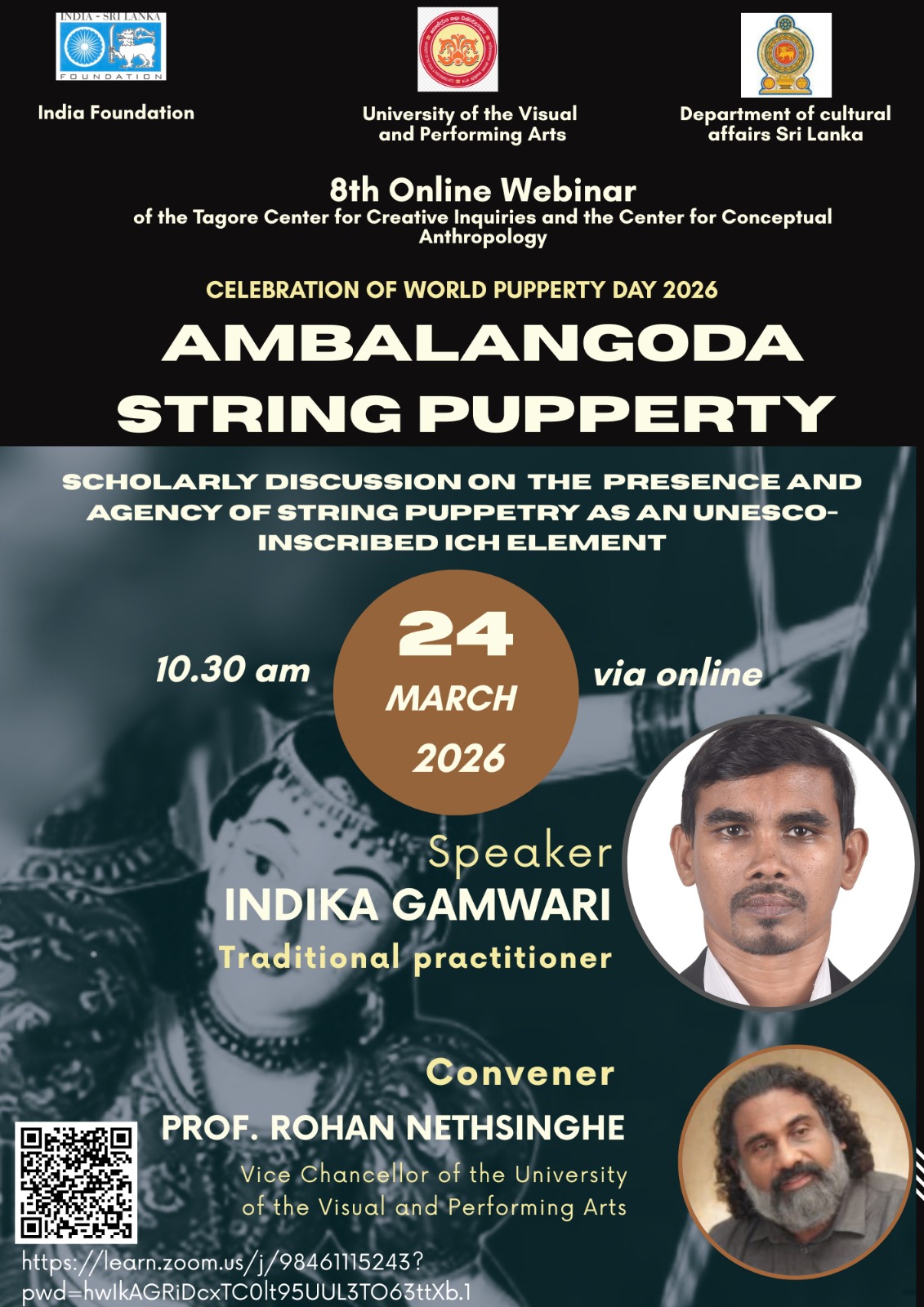
Session on Traditional String Puppetry in Sri Lanka
The Tagore Center for Creative Inquiry and the Centre for Conceptual Anthropology of the University of the Visual & Performing Arts successfully conducted an insightful session on traditional string puppetry in Sri Lanka, highlighting the importance of safeguarding this unique cultural tradition.
Traditional string puppetry is a significant art form and an integral part of Sri Lanka’s Intangible Cultural Heritage, reflecting the country’s history, storytelling traditions, and creative expressions. Notably, this tradition was inscribed on the Representative List of the Intangible Cultural Heritage of Humanity by UNESCO in 2018, highlighting its international recognition and cultural value. This tradition is not only culturally important but also aligns with global frameworks such as the Sustainable Development Goals (SDGs). It contributes to SDG 4 – Quality Education through intergenerational knowledge transmission, SDG 8 – Decent Work and Economic Growth by supporting the livelihoods of traditional artists, and SDG 11 – Sustainable Cities and Communities through safeguarding intangible cultural heritage.
The session was conducted by Ganwary Indika Gamini, a highly experienced traditional Sri Lankan string puppeteer. He has been engaged in puppetry from a young age under the guidance of his father, Ganwary Premin, a recipient of the Kala Keerthi title. Continuing a rich family legacy, his grandfather, Master Podisirina, is recognized as a key figure in the development of traditional string puppetry in Sri Lanka. Indika has performed extensively across Sri Lanka and internationally, representing the country at festivals in Germany, Thailand, Dubai, India, and China. He has also contributed to community engagement by conducting performances in post-tsunami affected areas and refugee camps in Vavuniya following the civil conflict. Furthermore, he is the founder of the Ambalangoda Puppet Theatre Festival and continues to perform alongside his family, passing this tradition on to the next generation.
The session provided valuable insights into the preservation, transmission, and contemporary relevance of traditional string puppetry in Sri Lanka, enriching the knowledge and appreciation of participants. Furthermore, it reflects the university’s ongoing commitment to cultural preservation, community engagement, and contribution to the Sustainable Development Goals. This initiative supported the University’s sustainability journey aligns with SDGs 4, 8, 11, and 17.